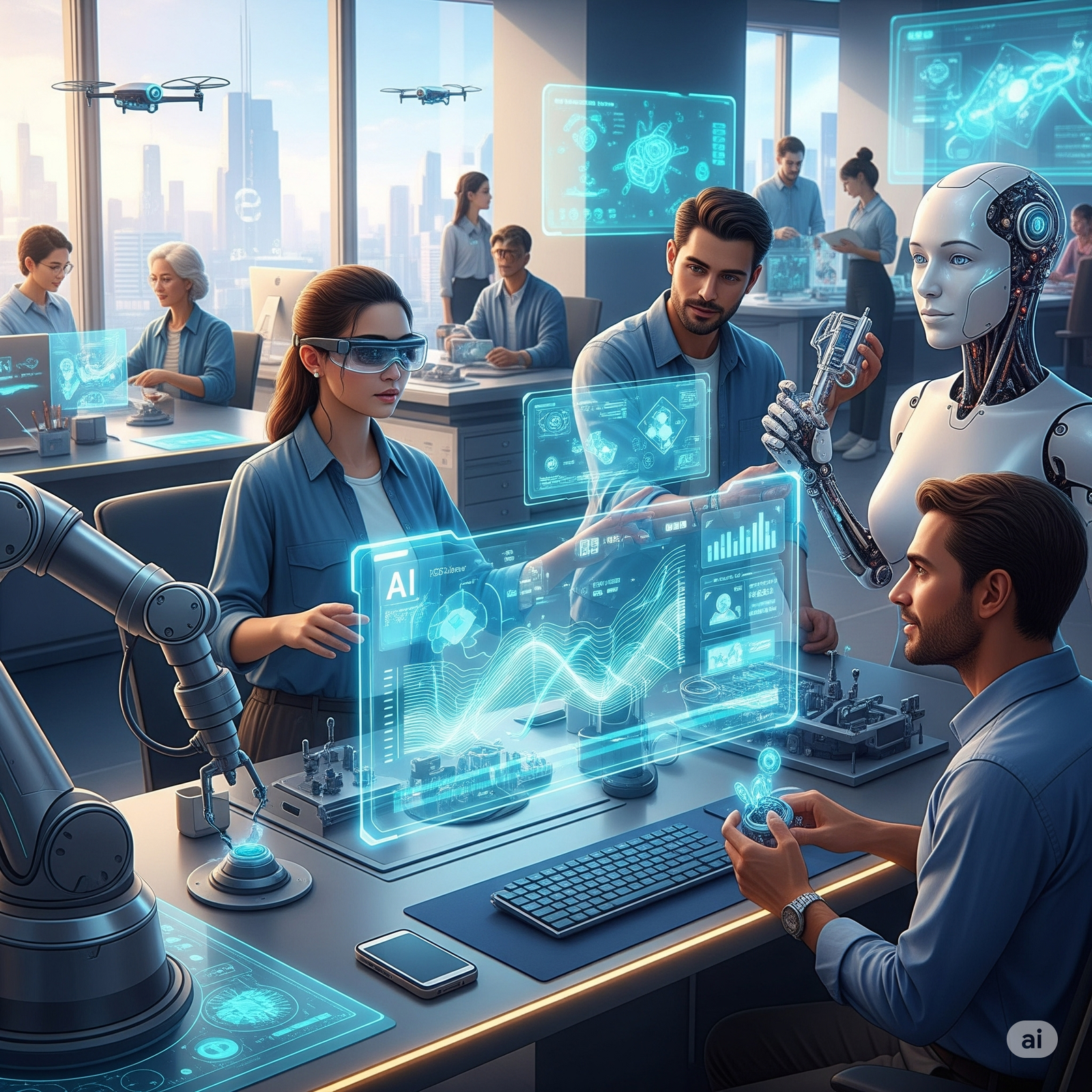
Artificial Intelligence is no longer a distant future—it’s here, shaping our work, creativity, and daily decisions. Yet the real question isn’t whether AI will replace humans, but how humans and AI will collaborate. The future belongs to partnerships where machines handle scale and speed while humans provide context, creativity, and empathy. Together, they can achieve outcomes neither could alone.
At Gen Z Academy, we’ve already seen early success stories where teams integrating AI tools reported a 40% boost in productivity while freeing human workers to focus on higher-level problem-solving.
Introduction: Beyond replacement fears
Much of the conversation around AI centers on job loss, but this narrative misses the bigger opportunity. History shows that new technologies shift work rather than erase it. The printing press didn’t eliminate writers—it created more readers. In the same way, AI is less about replacement and more about amplification. The key lies in designing workflows that combine human strengths with AI’s capabilities.
"The future of AI isn’t about humans vs. machines—it’s about humans with machines."
Where collaboration already shines
We’re already seeing strong human-AI partnerships in multiple domains:
- Healthcare: AI assists in diagnosis, while doctors apply empathy and judgment.
- Education: AI tutors provide personalized feedback, while teachers inspire curiosity.
- Creative fields: AI generates drafts, while humans refine, curate, and add originality.
- Customer support: Bots handle routine queries, while humans resolve complex cases.
Each example demonstrates a division of labor that increases efficiency without losing the human touch.
Challenges in collaboration
For all its promise, collaboration isn’t frictionless. Concerns include:
- Trust: Can people rely on AI outputs without blind dependence?
- Bias: If the training data is flawed, the collaboration suffers.
- Ethics: Who is responsible for decisions when humans and AI share tasks?
These challenges highlight the importance of transparency, governance, and human oversight in every AI partnership.
Strategies for building stronger partnerships
To harness the best of both worlds, organizations can:
- Redefine roles: Assign AI to repetitive tasks, while humans handle judgment-based decisions.
- Train both humans and AI: Just as people need upskilling, AI systems need fine-tuning.
- Embrace co-design: Build tools with input from both developers and end-users to ensure usability.
Done well, these strategies make AI an empowering partner rather than an intimidating rival.
Conclusion: A partnership-driven future
The future of work isn’t about choosing between human intelligence and artificial intelligence—it’s about combining them. Humans bring context, values, and creativity; AI brings speed, scale, and precision. Together, they form a partnership that’s greater than the sum of its parts. As we move forward, the organizations that thrive will be the ones that treat AI not as a replacement, but as a collaborator. The real future of AI is deeply human.